
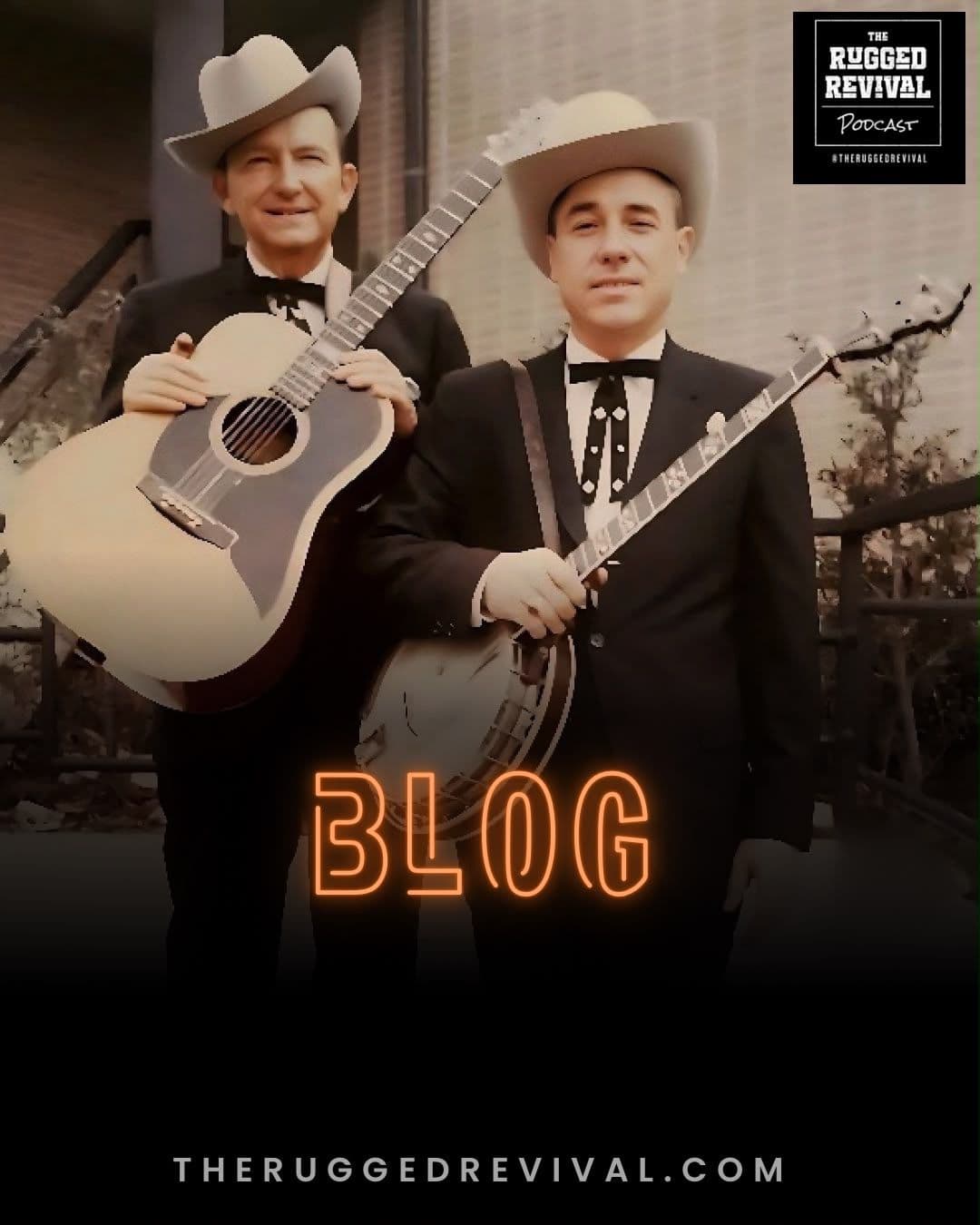
Bluegrass music is steeped in tradition, even more so than traditional country music. Amongst fans and musicians alike in both genres. Many bluegrass standards are passed down generations, from old church hymnals and gospel songs to songs of working the land and living in the mountains. You can imagine the feeling felt by purists far and wide, when that tradition is bucked. It’s blasphemy. Enter, Earl Scruggs & Lester Flatt. They single handedly took bluegrass to the masses, forever altering the trajectory of the genre. This eventually led to their demise, but the progress (or damage) was done.
Earl Scruggs and Lester Flatt were both part of Bill Monroe’s original Blue Grass Boy lineup. The genre “Bluegrass” stems from this band’s name, who preferred to play straightforward acoustic, “high lonesome” music with Guitar, mandolin, banjo, bass, and fiddle. This sound was in stark contrast to the traditional country music which had electric steel guitar, and eventually, full electric guitar. The onset of Rock ‘N’Roll, which creeped into Country Music, further divided the Bluegrass and Country crowds.
In 1948, Earl and Lester split from Bill Monroe to form their own band, Flatt & Scruggs. By 1950, they were signed to Columbia Records and began issuing singles for radio airplay. The duo were managed by Scruggs’s wife, Louise. This was a part of contention for their entire partnership. Louise had broader visions, and thought the duo needed a “facelift” from the old sound. She booked them to begin playing around to college campuses in the late 1950’s, and even signed them up to play folk festivals. This was an entirely different crowd than what they were used to.
Then came 1962, when they released the LP “Folk Songs of Our Land”. This was officially Flatt & Scruggs dipping their toes into new territory. Amongst the (12) tracks, (8) were still F&S originals. However, sprinkled within were songs by Woody Guthrie, Merle Travis and A.P. Carter. The sound of the album, sonically, was not as “hillbilly” as previous releases. Culminating with their touring in front of more youthful audiences, Hollywood producer Paul Henning tapped the duo to sing the theme song for his new TV pilot, “The Beverly Hillbillies”. The song , “The Ballad of Jed Clampett” was a massive hit, and was sent to radio as a single at the request of one Louise Scruggs. It became the first Bluegrass song to top the Billboard Country Charts (and stayed there for 4 weeks). It also approached the Top 40 on the Billboard Hot 100 Pop Chart. Flatt & Scruggs were now thrust into the living rooms of every American family.
The Flatt & Scruggs train didn’t stop there. What followed was a string of milestones that I am sure left bluegrass purists mystified. The duo performed the first ever Bluegrass show at Carnegie Hall, and recorded it for a live album released in 1963. Then came the Live at Vanderbilt University album of 1964, which proved that Flatt & Scruggs have now arrived…academically. Bluegrass was no longer just for low-IQ hillbilly mountain folk. Both albums were placed firmly within the Top 10 on Billboard Country Albums chart. Across the aisle, Bob Dylan went electric at the 1965 Newport Folk Festival, soliciting folk purists to also lose their collective minds. Music was changing, and so was culture and society.
The decade ended with “Nashville Airplane” released in 1968, and produced by Bob Johnston (Dylan, Simon & Garfunkel, Leonard Cohen). This LP strayed the furthest from their traditional bluegrass sound of their roots .No songs on this album were credited to Flatt nor Scruggs. What appeared were (4) songs by Dylan, songs by Buffy Saint-Marie, John Hartford, Tim Hardin, Donovan etc. This was a folk album. And the “folk” part was severely damaging the duo.
Lester Flatt was a purist. He continually made his displeasure known on the duo’s sound and their appearance. Earl Scruggs, however, was more interested in experimentation, the changing tides of America and the Liberal movement occurring with the nation’s youth. The duo broke up for good after their show on March 11, 1969, as the tensions were about to boil over. Flatt & Scruggs never played together again. Lester went on to record solo albums of straight-forward country and bluegrass music. Earl Scruggs established the Earl Scruggs Revue with his sons, blending all types of music together. Earl also appeared on dozens of albums and songs by a wide range of artists, and offered up his banjo services for many a studio recording.
Lester died in 1979, but Earl and he did reconcile as friends shortly before his death. The duo were inducted into the Country Music Hall of Fame in 1985, and were part of the first class of the IMBA Bluegrass Hall of Fame in 1991. Earl had a star placed on the Hollywood Walk of Fame in 2003, and passed away in 2012. Flatt & Scruggs left an indelible mark on not just Bluegrass, and as an extension Country music, but Popular music as well. Bluegrass no longer belonged to just Appalachian mountain people. It belonged to America.